9 Habits of Emotionally Intelligent People (And How to Develop Them)
Have you ever met someone who remains calm under pressure, handles conflict with grace, and seems to intuitively understand what others are feeling? These individuals aren't just "lucky" or "nice." They are practicing specific habits of emotionally intelligent people.
While IQ (Intelligence Quotient) might help you get a job, EQ (Emotional Quotient) is often what helps you keep it—and thrive in it. Emotional intelligence isn't a fixed trait you are born with; it is a set of learnable skills. By observing the characteristics of an emotional intelligent person, you can identify patterns in your own behavior and find areas for growth.
Whether you are looking to improve your leadership skills, deepen your relationships, or simply understand yourself better, adopting these habits can be transformative. In this guide, we will explore the 9 core behaviors that define high EQ and how you can apply them today.
If you are curious about where you currently stand, you might want to explore your traits with our emotional intelligence test to get a baseline before diving in.
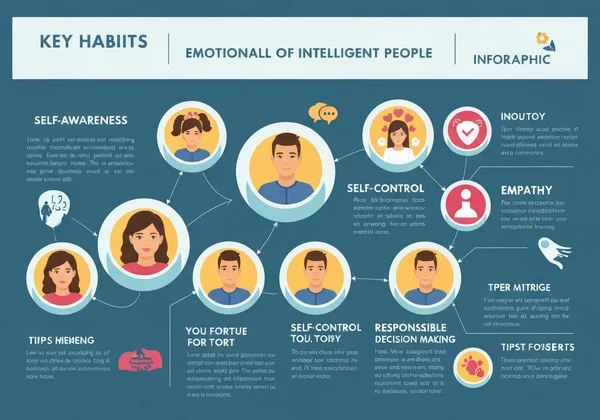
Why Emotional Intelligence Matters for Success
Before we unpack the specific habits, it is important to understand why this matters. In a world driven by data and automation, the human ability to connect remains irreplaceable.
High emotional intelligence correlates strongly with better mental health, superior job performance, and more satisfying relationships. For example, a leader with high EQ can motivate a team through a crisis without causing burnout. In a marriage, emotional intelligence examples include navigating a heated argument without resorting to personal attacks.
Ultimately, these habits act as a buffer against stress. They allow you to respond to life’s challenges with intention rather than reacting on impulse.
They Possess a Robust Emotional Vocabulary
Most people can easily identify when they feel "happy," "sad," or "angry." However, one of the primary habits of emotionally intelligent people is the ability to go much deeper. This is a concept known as "emotional granularity."
Instead of simply saying they are "stressed," a high-EQ person might pinpoint that they are actually feeling "overwhelmed," "undervalued," or "apprehensive."
Why This Matters
If you can’t name the emotion, you can’t manage it. "Anger" might require a cool-down period, but "disappointment" requires an adjustment of expectations. Being precise allows for a more effective solution.
Try This: Next time you feel a strong emotion, pause and try to come up with two other words that describe it more specifically.
They Pause Before Reacting
We have all sent a text message we regretted or snapped at a partner after a long day. The difference with high-EQ individuals is not that they don't feel the urge to react; it is that they cultivate a "gap" between the trigger and their response.
This "six-second pause" allows the rational part of the brain (the prefrontal cortex) to catch up with the emotional part (the amygdala).
The Pause in Action
- Trigger: A colleague criticizes your work publicly.
- Low EQ Reaction: Immediately argue back or shut down.
- High EQ Habit: Breathe. Notice the spike in heart rate. Wait until the wave of emotion settles before responding calmly.
They Are Not "Nice" All the Time (Setting Boundaries)
A common misconception regarding the emotionally intelligent person meaning is that they are always agreeable, soft-spoken, and "nice." This is false. High emotional intelligence requires the ability to be assertive and set firm boundaries.
If you are constantly saying "yes" when you want to say "no," you are not showing high EQ; you are likely people-pleasing, which leads to resentment and burnout.
Emotionally intelligent people understand that protecting their time and mental energy is essential. They can deliver a refusal kindly but firmly. They know that "no" is a complete sentence.
Reflection Point: Do you struggle to assert your needs? You can get a comprehensive emotional intelligence analysis on our platform to see how your assertiveness compares to your empathy scores.

They Handle Criticism Without Getting Defensive
Feedback can feel like a physical attack. Our natural instinct is to put up shields and defend our ego. However, one of the defining 9 habits of highly emotionally intelligent people is viewing criticism as data, not as an insult.
They ask themselves: "Is there any truth to this?"
If the criticism is valid, they use it to improve. If it is unfounded, they let it go without letting it ruin their day. They separate their self-worth from their performance or others' opinions.
They Are Deeply Curious About Others (True Empathy)
Many people confuse empathy with agreement. You don't have to agree with someone to empathize with them. High-EQ individuals possess a genuine curiosity about what makes other people tick.
This manifests as "active listening." Instead of waiting for their turn to speak, they focus entirely on understanding the other person's perspective. They ask questions like:
- "Can you tell me more about why you feel that way?"
- "What I'm hearing is that you're frustrated because..."
By validating others' feelings, they build trust and psychological safety in their relationships.
They Forgive, But They Don't Forget
Holding onto a grudge is like drinking poison and expecting the other person to die. Emotionally intelligent people understand that forgiveness is a gift they give themselves, not necessarily the offender.
They let go of the emotional charge and resentment because they know it negatively impacts their own well-being. However, this doesn't mean they are naive. They "don't forget" in the sense that they learn from the experience. They may forgive the person but adjust the boundaries of the relationship to ensure they aren't harmed again.
They Neutralize Toxic People
Dealing with difficult personalities is an unavoidable part of life. Whether it is a narcissistic boss or a dramatic friend, high-EQ individuals have strategies to handle them without getting sucked into the chaos.
They often use the "Gray Rock" method—becoming uninteresting and unresponsive to emotional manipulation. They control what they can (their reaction) and accept what they cannot (the other person's behavior). They do not allow toxic people to rent space in their heads rent-free.
They Know When to Trust Their Intuition
Emotional intelligence is the intersection of the heart and the head. It isn't about ignoring logic; it is about recognizing that emotions are a form of data.
When a high-EQ person has a "gut feeling" that a business deal is off or a person isn't trustworthy, they don't dismiss it. They investigate it. They trust their subconscious ability to recognize patterns that their conscious mind might not have processed yet.
They Focus on What They Can Control
Resilience is a key output of high EQ. When things go wrong, emotionally intelligent people don't waste energy blaming external circumstances or wishing things were different.
They pivot quickly to: "What can I do about this right now?"
By focusing their energy on their own actions and attitude—the only things truly under their control—they feel empowered rather than helpless, even in difficult situations.
Contrast: Habits of People With Low Emotional Intelligence
To fully understand the positive habits, it is helpful to look at the opposite. Here are 5 habits of people with very low emotional intelligence that serve as red flags:
- Playing the Victim: They refuse to take responsibility for their errors, always blaming others or bad luck.
- Frequent Emotional Outbursts: They have no "filter" or pause mechanism; anger or frustration is dumped instantly on those around them.
- Inability to Listen: They constantly interrupt or turn every conversation back to themselves.
- Tone Deafness: They make insensitive jokes or comments and are surprised when others are offended.
- Holding Grudges: They keep a scorecard of past wrongs and bring them up repeatedly in arguments.
Recognizing these behaviors is the first step toward changing them. If you see these patterns in yourself, don't panic—awareness is the catalyst for growth.
Can Emotional Intelligence Be Learned? (The Growth Mindset)
The short answer is yes.
Unlike IQ, which is relatively static throughout adulthood, emotional intelligence is highly plastic. Thanks to neuroplasticity, your brain can form new pathways. By consciously practicing the 9 habits of highly emotionally intelligent people listed above, you can physically rewire your brain to react differently to stress and social cues.
It requires practice, patience, and a willingness to be uncomfortable, but the ROI (Return on Investment) for your personal and professional life is immense.
Frequently Asked Questions
What is the difference between empathy and sympathy?
Sympathy is feeling for someone (e.g., "I'm sorry you are in pain"), often from a distance. Empathy is feeling with someone (e.g., "I can imagine how painful that must be for you"). Emotionally intelligent people practice empathy, which creates a deeper connection.
Do emotionally intelligent people ever get angry?
Yes, absolutely. High EQ doesn't mean you don't feel negative emotions. It means you recognize the anger, understand where it is coming from, and choose a constructive way to express it, rather than exploding or suppressing it.
What is an example of high emotional intelligence?
A classic example is a manager whose team misses a deadline. Instead of yelling (low EQ), the manager pauses, manages their own frustration, and asks the team, "What obstacles did we face, and how can we fix the process for next time?"
How do I know if I have high or low EQ?
Self-awareness is tricky because we all have blind spots. While reading articles helps, taking a structured assessment can provide objective data on your strengths and weaknesses.