Daniel Goleman Emotional Intelligence — The Complete Guide to EQ Theory and Growth
You have probably heard that emotional intelligence matters more than IQ. But what does that actually mean for your daily life? Daniel Goleman brought this idea to the mainstream in 1995 with his groundbreaking book, and the concept has shaped how we think about success, leadership, and personal growth ever since. This guide breaks down Goleman's emotional intelligence theory, walks you through the five core components, and gives you practical steps to strengthen your own EQ. If you want a quick snapshot of where you stand, you can explore this free EQ assessment before diving in.
What Is Daniel Goleman's Theory of Emotional Intelligence?
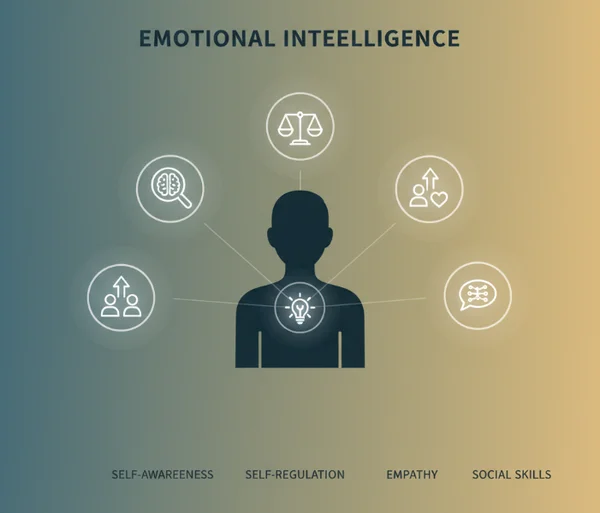
Daniel Goleman is a psychologist and former science journalist who popularized the concept of emotional intelligence through his 1995 bestseller, Emotional Intelligence: Why It Can Matter More Than IQ. His central argument is straightforward: being smart is not just about logic and problem-solving. It also involves how well you recognize emotions, manage your reactions, and connect with other people.
Goleman built on research by psychologists Peter Salovey and John Mayer, who first coined the term "emotional intelligence" in 1990. However, Goleman took the idea further by linking it directly to real-world outcomes like workplace performance, leadership effectiveness, and relationship quality.
How Goleman Defines Emotional Intelligence
In simple terms, emotional intelligence by Daniel Goleman refers to your ability to identify, understand, and manage your own emotions while also recognizing and influencing the emotions of others. Unlike IQ, which tends to stay relatively fixed, Goleman argues that EQ is a skill set you can develop throughout your entire life.
Why This Theory Changed How We Think About Success
Before Goleman's work, intelligence was measured almost entirely by cognitive ability. His book challenged that assumption with a powerful claim: emotional intelligence can matter more than IQ in determining personal and professional success. This idea resonated with educators, business leaders, and everyday readers who had always sensed that "book smarts" only told part of the story.
What Are the 5 Components of Emotional Intelligence?
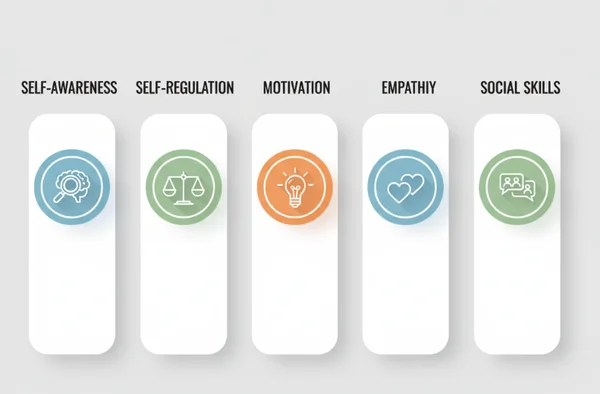
The emotional intelligence Daniel Goleman summary most people know revolves around five core components. These building blocks work together to shape how you experience and express emotions in every area of life.
Self-Awareness — Recognizing Your Emotional Patterns
Self-awareness is the foundation. It means noticing what you feel, when you feel it, and understanding how those emotions influence your thoughts and behavior. A self-aware person can step back during a stressful meeting and think, "I am feeling defensive right now because this feedback touches on something I am insecure about."
Without self-awareness, you may react on autopilot. With it, you gain the ability to pause and choose a more thoughtful response.
Self-Regulation — Managing Impulses and Reactions
Self-regulation builds on self-awareness. Once you recognize an emotion, the next challenge is managing it. This does not mean suppressing feelings. Instead, it means expressing them in ways that are constructive rather than harmful.
For example, when a colleague takes credit for your idea, self-regulation helps you address the situation calmly rather than lashing out in front of the team. Goleman emphasizes that people who self-regulate tend to be more adaptable, trustworthy, and comfortable with ambiguity.
Motivation — Driving Yourself Beyond External Rewards
Goleman's third component focuses on intrinsic motivation, the inner drive to pursue goals because they matter to you, not just because of a paycheck or promotion. Motivated individuals tend to set higher standards for themselves, remain optimistic after setbacks, and stay committed even when progress is slow.
This component separates people who merely meet expectations from those who consistently exceed them.
Empathy — Understanding What Others Feel and Need
Empathy goes beyond simply knowing that someone else is upset. It involves actively considering their perspective and responding with genuine care. In a workplace setting, empathy helps managers sense when a team member is struggling, even if that person has not said anything directly.
Goleman identifies empathy as a critical skill for leadership because it fuels trust and psychological safety within teams.
Social Skills — Building Relationships That Work
Social skills tie all the other components together. This dimension includes communication, conflict resolution, collaboration, and the ability to inspire others. A person with strong social skills can navigate difficult conversations, build rapport quickly, and create an environment where people feel valued.
Goleman describes social skills as "friendliness with a purpose." It is not just about being likable. It is about managing relationships to move toward shared goals.
How Does Emotional Intelligence Compare to IQ?
One of the most discussed aspects of Daniel Goleman's emotional intelligence book is the comparison between EQ and IQ. Many readers come to this topic with a specific question: which one matters more?
Key Differences Between EQ and IQ
| Factor | IQ (Cognitive Intelligence) | EQ (Emotional Intelligence) |
|---|---|---|
| Nature | Largely stable over time | Can be developed at any age |
| Measurement | Standardized tests | Self-assessment, behavioral observation |
| Focus | Logic, reasoning, problem-solving | Emotions, relationships, self-management |
| Impact on career | Helps you get hired | Helps you lead and advance |
| Trainability | Difficult to change significantly | Highly trainable with practice |
Why Goleman Argues EQ Often Matters More
Goleman does not dismiss IQ. Instead, he points out that beyond a certain threshold of cognitive ability, EQ becomes the stronger predictor of success. In his research on leadership, he found that the most effective leaders were not always the smartest in the room. They were the ones who could manage their emotions, read a room, inspire trust, and navigate conflict.
This does not mean IQ is irrelevant. It means that once you meet a baseline level of intelligence for your role, your emotional skills become the factor that sets you apart.
What Are the Four Domains and Twelve Competencies?
In later work, particularly the 2002 book Primal Leadership, Goleman refined his framework into a more structured model. This updated version organizes emotional intelligence into four domains, each containing specific competencies.
Self-Awareness Domain
This domain contains one key competency: Emotional Self-Awareness. It involves accurately recognizing your emotions and understanding how they affect your performance, decisions, and interactions.
Self-Management Domain
Self-Management includes four competencies: Emotional Self-Control, Adaptability, Achievement Orientation, and Positive Outlook. Together, these skills help you stay composed under pressure, bounce back from setbacks, and maintain a constructive mindset.
Social Awareness Domain
This domain covers Empathy and Organizational Awareness. Beyond individual empathy, organizational awareness involves reading the emotional currents and power dynamics within a group or company.
Relationship Management Domain
The broadest domain includes Influence, Coach and Mentor, Conflict Management, Teamwork, and Inspirational Leadership. These competencies are especially relevant for anyone in a management or leadership role.
How Can You Develop Your Emotional Intelligence?
One of the most encouraging aspects of Daniel Goleman's emotional intelligence theory is the idea that EQ is not fixed. You can strengthen it at any age with consistent effort. Here are practical strategies organized around the five components.
Steps to Build Self-Awareness
- Keep a brief emotion journal. At the end of each day, note two or three moments when you felt a strong emotion and what triggered it.
- Ask for honest feedback from people you trust about how you come across in stressful situations.
- Practice mindfulness or brief check-ins throughout the day. Simply asking yourself, "What am I feeling right now?" can sharpen your self-awareness over time.
Steps to Strengthen Self-Regulation
- When you feel a strong negative reaction, pause for ten seconds before responding. This creates space between impulse and action.
- Identify your personal triggers. Knowing what consistently pushes your buttons makes it easier to prepare a measured response.
- Develop a go-to calming technique, whether that is deep breathing, a short walk, or mentally reframing the situation.
Steps to Boost Motivation
- Connect your daily tasks to a larger personal purpose. When you understand why your work matters to you, routine tasks feel more meaningful.
- Set small, specific goals and celebrate progress. Momentum builds motivation more effectively than willpower alone.
Steps to Practice Empathy
- During conversations, focus on listening before formulating your response. Give the other person your full attention.
- Try to name what the other person might be feeling. Even if you get it wrong, the attempt signals genuine care.
- Read fiction or watch films that explore diverse perspectives. Research suggests this can strengthen your empathy circuits.
Steps to Improve Social Skills
- Practice giving specific, positive feedback to colleagues or friends. People respond better to clear appreciation than vague praise.
- In conflict situations, focus on the issue rather than the person. Use "I" statements to express your perspective without assigning blame.
- Look for opportunities to collaborate rather than compete. Strong social skills often come from a habit of finding shared goals.
How Does Emotional Intelligence Apply in the Workplace?
Emotional intelligence Daniel Goleman's work has had a massive influence on how organizations approach leadership development, team dynamics, and hiring. Understanding how EQ shows up at work can help you apply these ideas beyond personal reflection.
EQ and Leadership Effectiveness
Goleman's research found that emotional intelligence accounts for nearly 90 percent of the difference between average and outstanding leaders. Leaders with high EQ create environments where people feel heard, valued, and motivated, which directly impacts team retention and productivity.
EQ in Everyday Work Situations
You do not need to be a manager to benefit from emotional intelligence at work. Consider these common scenarios:
- Receiving critical feedback: Self-awareness helps you recognize defensive reactions. Self-regulation helps you respond constructively.
- Navigating team conflict: Empathy lets you understand each side. Social skills help you facilitate a resolution.
- Pitching an idea: Motivation keeps you persistent. Social skills help you read the room and adjust your approach.
Where Do You Stand With Your Emotional Intelligence?
Reading about emotional intelligence is a solid first step. However, understanding how these concepts apply to your own life requires a deeper look inward. Self-reflection is powerful, but it can be difficult to be fully objective about your own emotional patterns.
That is where a structured self-reflection tool can help. An EQ test for self-insight can provide a starting point to organize your thoughts about your strengths and growth areas across these five components. It is not a clinical diagnosis. Think of it as a mirror that helps you see patterns you might otherwise miss.
This type of assessment is designed for self-understanding and personal growth. It does not replace professional evaluation or mental health support.
Key Takeaways From Daniel Goleman's Emotional Intelligence
Daniel Goleman's emotional intelligence framework has transformed how millions of people think about success, relationships, and personal growth. Here are the core ideas to carry forward:
- Emotional intelligence is a different kind of smart, one that involves self-awareness, self-regulation, motivation, empathy, and social skills.
- Unlike IQ, EQ can be developed and strengthened throughout your life.
- In leadership and workplace settings, emotional intelligence often matters more than cognitive ability for outstanding performance.
- Goleman's four-domain model with twelve competencies provides a practical roadmap for growth.
- Small daily practices, like journaling, active listening, and pausing before reacting, compound into meaningful change over time.
If you are curious about how your emotional intelligence shows up in real life, consider taking a moment to try an EQ self-assessment and see what patterns emerge. Whatever your starting point, the science is clear: emotional intelligence is a skill worth building.
Frequently Asked Questions
What is Daniel Goleman's theory of emotional intelligence?
Goleman's theory proposes that emotional intelligence, the ability to recognize, manage, and respond to emotions in yourself and others, is as important as IQ for success in life, work, and relationships. He popularized this idea through his 1995 bestseller.
What are the 5 components of emotional intelligence according to Daniel Goleman?
The five components are self-awareness, self-regulation, motivation, empathy, and social skills. Together, they form the foundation of how you understand and manage emotions in everyday situations.
Can emotional intelligence be learned or developed?
Yes. Goleman emphasizes that unlike IQ, emotional intelligence is a set of skills you can strengthen at any age through practices like mindfulness, active listening, feedback-seeking, and intentional self-reflection.
Why does Goleman say emotional intelligence matters more than IQ?
Goleman argues that beyond a baseline level of cognitive ability, EQ becomes a stronger predictor of success, especially in leadership roles. Leaders who manage emotions well build trust, resolve conflict, and inspire their teams more effectively.
What are the four domains of emotional intelligence?
Goleman's updated model includes Self-Awareness, Self-Management, Social Awareness, and Relationship Management. Each domain contains specific competencies that can be practiced and improved over time.
How does emotional intelligence affect leadership?
Leaders with high EQ create psychologically safe environments, navigate conflict constructively, and motivate teams more effectively. Goleman's research suggests EQ is the single biggest differentiator between average and outstanding leaders.
What is the difference between emotional intelligence and IQ?
IQ measures cognitive abilities like logic and reasoning and tends to remain stable. EQ measures emotional and social skills and can be developed throughout life. Both matter, but EQ may have a greater impact on interpersonal success and leadership.