Decoding Your EQ Test Score: What the Numbers Mean
Have you just completed an EQ test and are now staring at a number, wondering what it truly reveals about you? You're not alone. Many of us seek to understand our emotional world, but interpreting the results can feel like trying to read a map without a legend. What is a normal EQ score? This guide is here to be your legend. We will demystify your emotional intelligence score, explore what different levels signify, and show you how this single number can be the starting point for profound personal and professional growth.
An emotional intelligence assessment is more than just a quiz; it’s a mirror reflecting your inner landscape. Whether your score is high, low, or somewhere in the middle, it holds valuable clues for self-improvement. The first step is understanding what you’re looking at. If you haven't discovered your score yet, you can take our free EQ test to get your baseline.

What is an EQ Score & How is it Measured?
Your EQ score is a numerical representation of your emotional intelligence at a specific point in time. Unlike an IQ score, which measures cognitive ability and is relatively stable, your EQ score is dynamic. It reflects your current capacity to perceive, evaluate, and regulate your own emotions and the emotions of others. Think of it less as a permanent label and more as a snapshot of a skill set you can actively develop.
A scientifically-validated emotional intelligence test doesn't ask random questions. It presents you with situational scenarios designed to gauge your abilities across key areas. By analyzing your responses, the test calculates a score that maps out your emotional competencies. This provides a clear, data-driven foundation for self-discovery.
The Core Dimensions of Emotional Intelligence
To truly grasp your score, it's essential to understand what it's measuring. Most psychological models, including the one our EQ assessment is built upon, evaluate five core pillars:
- Self-Awareness: The ability to recognize and understand your own moods, emotions, and drives, as well as their effect on others.
- Self-Regulation: The capacity to control or redirect disruptive impulses and moods. It's about thinking before you act.
- Motivation: A passion for work for reasons that go beyond money or status. It involves a propensity to pursue goals with energy and persistence.
- Empathy: The ability to understand the emotional makeup of other people. This is fundamental to managing relationships and teamwork.
- Social Skills: Proficiency in managing relationships and building networks. It’s the ability to find common ground and build rapport.
Your overall emotional intelligence score is a composite of your strengths and weaknesses across these five critical areas.
Understanding EQ Testing Methodologies
A reliable EQ assessment is grounded in established psychological theory. The questions are carefully crafted to be more than simple self-reports; they measure how you are likely to apply emotional skills in real-world contexts. This approach ensures the results are not just abstract but are tied to practical behaviors and tendencies.
Our platform's test is designed based on these proven principles to provide you with a trustworthy initial score. For those seeking to go deeper, our optional AI-powered report analyzes your unique response patterns to give you a highly personalized roadmap for growth. Understanding the methodology helps you trust the process and, more importantly, the results. You can discover your results with confidence.
What is a Normal EQ Score?
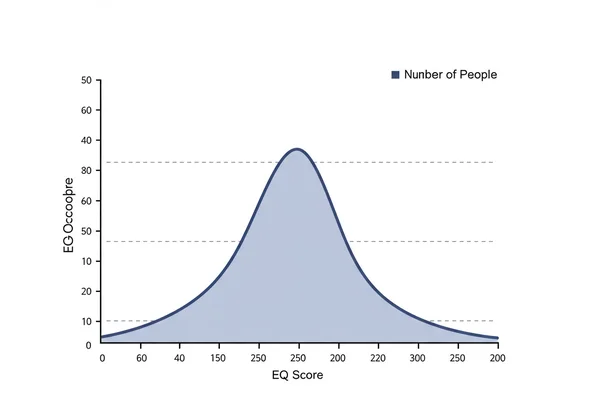
This is one of the most common questions people have after taking an online eq test. The truth is, there isn't a single "perfect" score. Emotional intelligence, like many human traits, typically falls along a bell curve. This means that most people will score within an average range, with fewer individuals at the very high or very low ends.
Instead of fixating on a specific number, it's more productive to view your score as a reference point. A "normal" or average score simply indicates that your emotional skills are on par with the general population. It doesn't mean you have no room for growth, nor does it diminish your existing strengths. The real value lies in understanding where you stand so you can chart a course for where you want to go.
Average EQ Scores: Benchmarks and Context
While specific numbers vary between different tests, average EQ scores generally cluster around the midpoint of the scoring scale (e.g., 100 on a scale similar to IQ). A score in this range suggests a solid foundation in emotional skills. You likely navigate most social situations effectively but may face challenges in highly stressful or emotionally charged circumstances.
Viewing your score in context is key. It's a benchmark, not a judgment. It helps answer the question, "How am I doing compared to others?" but the more important question is, "How can I use this information to improve myself?" The journey to improve emotional intelligence begins with this honest self-assessment.
Factors That Can Influence Your Emotional Quotient
Your emotional quotient is not set in stone. Several factors can influence your score at any given time, which is why it's a measure of your current state. These factors include your mood on the day of the test, recent life events, stress levels, and even your physical health.
Furthermore, your life experiences and conscious efforts toward personal development play a significant role. Someone who has actively worked on their communication skills or practiced mindfulness will likely see that reflected in their score. This is fantastic news because it confirms that EQ is a skill you can cultivate with intention and practice.
Interpreting Your EQ Test Score: Highs, Lows, & Growth
Once you have your number, the real work begins. To interpret your EQ test, you must look beyond the single digit and understand the story it tells about your strengths and opportunities. Every score, whether high or low, offers a unique pathway to becoming a more effective leader, a more empathetic friend, and a more self-aware individual.

What a High EQ Score Signifies
A high score is a wonderful affirmation of your emotional strengths. Individuals with high EQ typically excel in several areas. They are often highly self-aware, capable of recognizing their feelings as they happen. They manage stress well, remain optimistic even in the face of setbacks, and communicate their ideas persuasively.
In social settings, these individuals are adept at sensing the feelings of others and responding with empathy. This makes them natural leaders, valued team members, and supportive friends. If you have a high score, your next step is to learn how to consciously leverage these strengths in your career and relationships for maximum positive impact.
What a Low EQ Score Means (And Why It's an Opportunity)
Receiving a low score can be disheartening, but it is crucial to reframe it as an opportunity. A low score does not mean you are "bad" with emotions; it simply highlights blind spots you may not have been aware of. The signs of low emotional intelligence often manifest as difficulty managing stress, frequent misunderstandings in relationships, or trouble influencing others.
Seeing these challenges reflected in your score is the first, most powerful step toward addressing them. This new awareness empowers you to target specific areas for development. Perhaps you need to work on listening skills or find healthier ways to cope with frustration. Your score isn't a final verdict; it's the start of an exciting journey of personal growth.
Beyond the Numbers: Turning Insights into Action
Your EQ test score provides the "what." It tells you your current level of emotional intelligence. The real transformation, however, comes from understanding the "how"—how to use this insight to make tangible changes in your life. This is where moving beyond a simple score becomes essential.
To truly ignite your personal growth, you need a tailored plan. Our free test gives you the crucial starting point. For those ready to take the next step, our AI-powered deep analysis report translates your score into a personalized action plan, identifying your unique challenges and providing concrete strategies to improve emotional intelligence. It turns insight into a clear, actionable roadmap.
Ready to Unlock Your EQ Potential?
Your EQ score is a powerful tool for self-insight, not a final judgment. By understanding what the numbers mean, you've taken the first and most crucial step toward mastering your emotional world. This knowledge empowers you to build stronger relationships, excel in your career, and lead a more fulfilling life. It's a journey of continuous learning and growth.
Are you ready to discover your emotional strengths and unlock your full potential? Start your EQ Test today. It’s free, scientifically validated, and the perfect first step on your path to self-discovery.
Frequently Asked Questions About Your EQ Score
What is a normal EQ score?
A "normal" or average EQ score typically falls within the middle range of the test's scale. However, it's more useful to see it as a baseline for your personal growth journey rather than a fixed label. The goal is to understand your unique profile and identify areas for improvement.
How do I check my EQ level accurately?
To get a reliable measure, you should use a scientifically-backed assessment. An accurate eq test uses situational questions based on established psychological models. For a comprehensive understanding, you can take an accurate test on our platform, which provides an instant score and summary for free.
Can I raise my EQ over time?
Absolutely! Unlike IQ, emotional intelligence is a flexible set of skills that can be learned and enhanced. Through conscious effort, practice, and self-reflection—such as mindfulness, active listening, and empathy exercises—you can significantly raise your EQ.
What are the signs of low emotional intelligence?
Common signs include difficulty handling stress, frequent arguments, blaming others for mistakes, and an inability to understand or empathize with others' feelings. Recognizing these signs is the first step toward building greater emotional awareness and skill.
Is high EQ or IQ more important for success?
Both are important, but they contribute to success in different ways. While IQ is a strong predictor of academic achievement and the ability to handle complex technical tasks, many studies show that EQ is a stronger predictor of leadership effectiveness, job performance, and life satisfaction. Ideally, a balance of both is most powerful.