Empathising Quotient: Meaning, Scoring, and What It Can Tell You About Empathy
The empathising quotient is a self-report way to explore how easily you notice, understand, and respond to other people's feelings. People search for it under several spellings, including empathy quotient, empathizing quotient, and empathising quotient questionnaire, but the core idea is the same: it offers a structured reflection on empathy-related habits. If you are already exploring emotional intelligence, a practical EQ self-reflection tool can help you place empathy beside other skills such as self-awareness, self-regulation, motivation, and social communication. The result is not a label or a clinical answer. It is a prompt for noticing patterns: how you read social cues, how you react to emotion, and where you may want to practice more intentional listening.

What the Empathising Quotient Means
The Empathising Quotient, often shortened to EQ in research contexts, was developed by Simon Baron-Cohen and Sally Wheelwright as a measure of empathy in adults. Because EQ also means emotional quotient or emotional intelligence in everyday search, the phrase can be confusing. In this article, empathising quotient refers specifically to empathy-related measurement, not the broader emotional intelligence score used by many workplace and growth tools.
Empathy itself is not one single behavior. It usually includes cognitive empathy, which is the ability to infer what another person may be thinking or feeling, and affective or emotional empathy, which is the tendency to resonate with another person's emotional state. Social skill also matters because noticing emotion is different from responding well in conversation. A person can care deeply yet miss a cue, or understand the cue yet struggle to choose the right response.
That is why an empathising quotient score should be read as a snapshot of self-reported tendencies. It can point toward useful questions, but it cannot capture every kind of kindness, compassion, culture, communication style, or life experience.
Empathy Quotient Test Versions: 60 Questions, 40 Questions, and Shorter Forms
The original Empathy Quotient test included 60 questions. Forty items were empathy-related, while the remaining items were fillers that helped make the questionnaire feel less repetitive. Many modern references discuss the 40-item version because it keeps the scored empathy items and removes the fillers. You may also see shorter research versions or related instruments, such as the Toronto Empathy Questionnaire, which focuses more directly on emotional empathy.
For searchers comparing an empathizing quotient test with an empathy quotient test PDF or questionnaire PDF, the key question is whether the tool explains what it measures, how scoring works, who it was designed for, and what its limits are.
The format is usually a self-report scale. You read statements about social situations, emotional reactions, or perspective-taking, then choose how strongly you agree or disagree. Some items are reverse-scored, meaning disagreement may add points where agreement would not. This helps reduce simple "agree with everything" response patterns, though it can also make scoring feel less intuitive.
Empathy Quotient Scoring in Plain English
In common 40-item scoring, total scores often range from 0 to 80. Higher scores generally reflect stronger self-reported empathy-related tendencies. Some sources describe broad bands such as low, moderate, high, or very high. However, score ranges should be handled carefully because different versions, samples, and interpretation guides may use different cut points.
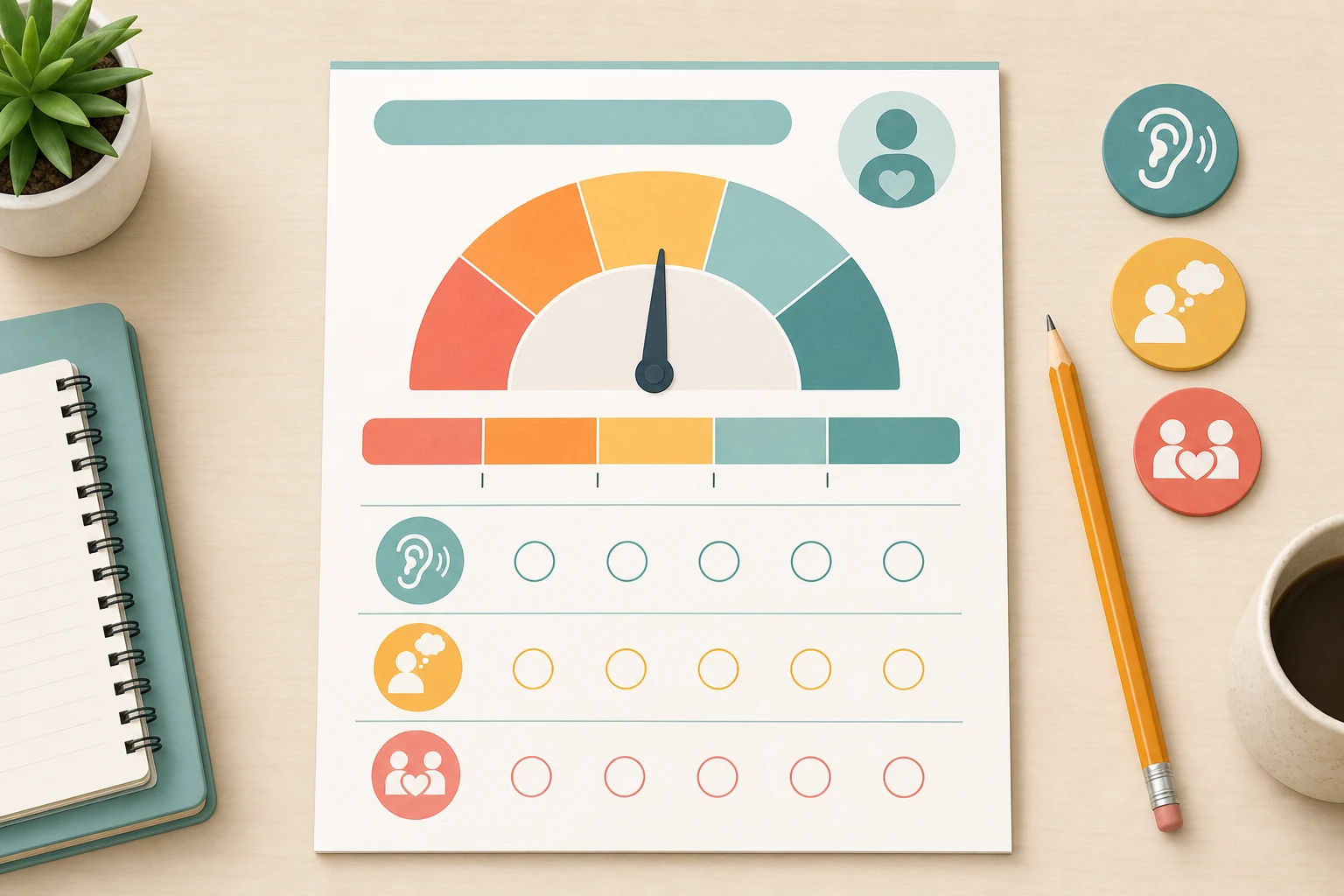
A high score on the Empathy Quotient may suggest that you often notice others' feelings, imagine their perspective, and feel concern when people are distressed. A lower score may suggest that some social cues or emotional signals are harder to interpret, or that your self-report style is more literal, reserved, or context-dependent. Neither result proves how caring a person is. Self-report tools are influenced by mood, confidence, culture, wording, and how you interpret social situations.
Very high empathy can also feel heavy. Some people absorb emotional tone quickly or become drained by conflict. In that case, growth may mean combining empathy with boundaries, emotional regulation, and clear communication.
If you want to compare empathy with broader emotional intelligence, an online EQ growth check can give you a wider lens. Emotional intelligence includes empathy, but it also includes how you notice your own emotions, manage reactions, stay motivated, and navigate relationships over time.
Empathising and Systemising Quotient: How They Relate
The phrase empathising systemising quotient comes from a research tradition that compares two broad cognitive styles: empathising and systemising. Empathising is about understanding people, feelings, intentions, and social signals. Systemising is about analyzing rules, patterns, systems, and predictable structures. In simple terms, empathising asks "What might this person be experiencing?" while systemising asks "How does this system work?"

These are not moral categories. A person can be strong in both, lower in both, or different across situations. Someone may excel at technical pattern recognition and also be highly responsive in close relationships.
For everyday readers, the most useful takeaway is balance. Empathy helps humanize decisions, while systemising helps structure problems. In work, relationships, parenting, coaching, and learning, both can support better outcomes. The goal is not to force yourself into a type. It is to notice which mode you reach for first and where another mode might add value.
Are High IQ People More Empathetic?
High IQ does not automatically mean high empathy. Cognitive ability can help someone analyze complex situations, remember social details, or infer possibilities, but empathy also involves attention, emotional openness, motivation, practice, and the ability to respond appropriately. A very analytical person may understand a situation quickly but still miss the emotional tone. A person with average analytical ability may be deeply attuned, patient, and supportive.
It is more useful to separate three questions. Can I understand another person's perspective? Can I feel concern without becoming overwhelmed? Can I respond respectfully? The empathising quotient mostly speaks to these empathy-related patterns, while IQ speaks to different abilities.
This distinction can reduce self-judgment. If your empathy score is lower than expected, it does not mean you lack care. It may mean you benefit from clearer cues, more time to process, or practice with active listening. If your score is high, it does not mean every response will land well. You may still need boundaries, self-awareness, and feedback.
How to Improve Your Empathy Quotient Without Forcing It
Improving your empathy quotient is less about becoming a different person and more about practicing small, repeatable habits. Start with attention. In one conversation each day, notice the other person's words, pace, facial expression, and what they avoid saying. Then reflect back one specific thing: "It sounds like the deadline pressure is the hardest part." This kind of response tests your understanding without pretending certainty.
Second, separate empathy from agreement. You can understand why someone feels disappointed without agreeing with every conclusion they draw. This makes empathy more sustainable, especially in conflict. Try a sentence such as, "I can see why that felt frustrating, and I want to understand the part that mattered most to you."
Third, practice curiosity before advice. Many people offer solutions too early because they want to help. A better first step is often one more question: "What would feel supportive right now?" or "Do you want advice, or do you want me to listen first?" These questions make empathy practical rather than performative.
Fourth, use emotional self-awareness. If another person's feelings trigger defensiveness, pause long enough to name your own reaction privately. You may notice embarrassment, pressure, fear of being blamed, or simple fatigue. Managing that reaction gives you more room to respond with care.
Common Mistakes When Reading an Empathising Quotient Score
The first mistake is treating one score as a complete social identity. Scores are simplified summaries. They do not show every relationship, every culture, every communication setting, or every moment of growth. They also do not show whether someone is kind in action when it matters.
The second mistake is comparing scores without context. If two people use different versions of the questionnaire, different scoring guides, or different interpretations of the answer choices, their totals may not mean the same thing. Even with the same version, self-report confidence can vary. Some people underrate themselves because they notice every missed cue. Others overrate themselves because they remember their intentions more than the effect on others.
The third mistake is assuming empathy is always comfortable. Healthy empathy includes limits. If you feel overwhelmed by others' distress, improvement may mean better boundaries, not more emotional absorption. If you feel detached in tense moments, improvement may mean slowing down and asking clearer questions, not criticizing yourself.
Use Your Empathising Quotient as a Starting Point
The empathising quotient is most helpful when you treat it as a mirror, not a verdict. It can help you ask sharper questions: Do I notice subtle emotional cues? Do I check my assumptions? Do I listen before solving? Do I combine compassion with boundaries? Those questions connect directly to the broader emotional intelligence skills that shape communication, relationships, and leadership.
For a wider view, you can explore emotional intelligence self-assessment and growth resources that place empathy alongside self-awareness, self-management, motivation, and social skills. Keep the process low-pressure. Use your results to choose one small behavior to practice this week, then pay attention to real feedback from conversations. Over time, that feedback is often more valuable than any single score.
FAQ
What is a high score on the Empathy Quotient?
On many 40-item versions, scores can range from 0 to 80, with higher totals generally reflecting stronger self-reported empathy. Some interpretation guides describe scores in bands such as low, moderate, high, or very high. Because ranges can differ by version and sample, read any score with the specific guide that came with the questionnaire.
What is the Empathy Quotient test 60 questions?
The 60-question version is the original form associated with Baron-Cohen and Wheelwright's Empathy Quotient. It includes 40 empathy-scored items and 20 filler items. The filler items do not usually contribute to the empathy score, but they help reduce repetition and make the questionnaire less obvious.
Is empathising quotient the same as emotional quotient?
No. The empathising quotient focuses on empathy-related tendencies, such as perspective-taking, emotional responsiveness, and social understanding. Emotional quotient, or broader EQ, usually refers to emotional intelligence, which also includes self-awareness, self-regulation, motivation, and relationship skills.
What does empathy quotient meaning usually refer to?
It usually refers to a questionnaire-based estimate of empathy-related traits. The meaning is not "how good" or "how valuable" a person is. It is a structured way to reflect on how someone reports noticing, understanding, and responding to other people's emotions.
Can I improve my Empathy Quotient?
You can often improve empathy-related habits through active listening, perspective-taking, emotional self-awareness, and feedback. A score may shift over time, but the more important goal is better real-world communication: understanding people more accurately and responding with more care.
Are high IQ people more empathetic?
Not automatically. IQ and empathy describe different abilities. Analytical skill may help someone reason through social situations, but empathy also depends on attention, emotional openness, motivation, and practice. A person can be high in one, both, or neither.
Should I use an empathy quotient questionnaire PDF?
A PDF can be useful for reading or self-scoring, but make sure it clearly explains the version, scoring rules, and limitations. Avoid treating an informal PDF score as a complete personal answer. Use it as one reflection tool alongside real conversations and, when needed, support from a qualified professional.