How to Control Your Emotions Without Letting Them Control You
To control your emotions does not mean becoming cold, silent, or unaffected. It means noticing what is happening inside you early enough to choose a response you can respect later. That skill matters at work, in relationships, during conflict, and in the private moments when your thoughts start moving faster than your judgment. If you want a simple baseline for your emotional patterns, a quick EQ self-reflection can help you connect this topic with self-awareness, self-regulation, empathy, and social skills. From there, the goal is practical: slow the reaction, understand the feeling, and act in a way that protects both your values and your relationships.

What It Means to Control Your Emotions
The phrase "control your emotions" can be misleading. Emotions are not switches. You cannot command anger, fear, sadness, or excitement to vanish on schedule, and trying to force them away often makes them louder. Emotional control is better understood as emotional regulation: the ability to notice a feeling, tolerate the physical surge, understand the meaning behind it, and choose behavior that fits the situation.
That distinction matters because many people confuse control with suppression. Suppression says, "I should not feel this." Regulation says, "I do feel this, and I can decide what to do next." One creates pressure. The other creates space.
In emotional intelligence terms, controlling your emotions sits mostly inside self-awareness and self-regulation. Self-awareness helps you recognize the feeling before it takes over your tone, posture, words, or decisions. Self-regulation helps you pause long enough to respond with more care. Neither skill makes you perfect. They simply make you more available to yourself before the moment hardens into a reaction.
Why Emotions Feel Hard to Control in the Moment
Emotions become difficult to manage because they are not just thoughts. They include body signals, memory, expectation, personal meaning, and social threat. A comment from a partner, a dismissive email, a public mistake, or a sudden disappointment can trigger a quick physical response before your reflective mind has caught up.
People often ask what part of the brain controls emotions. The honest answer is that emotion is not handled by one single part. Several brain systems are involved in noticing threat, reading social cues, remembering past experiences, and planning behavior. In everyday language, this means your body may prepare to defend, explain, withdraw, or attack before you have fully understood what happened.
That is why advice like "just calm down" rarely helps. When your jaw tightens, your chest gets hot, your breathing changes, or your thoughts become absolute, you are already inside the emotional wave. The first task is not to win an argument with the feeling. It is to slow the wave enough that you can see more than one possible response.
Common signs that emotions are beginning to control the moment include:
- You speak faster, louder, or more sharply than intended.
- You assume the other person's motive without checking.
- You feel an urgent need to send the message, prove the point, or leave immediately.
- You replay one sentence in your head as if it explains the whole situation.
- You treat discomfort as danger, even when no immediate danger is present.
Noticing these signs gives you a practical entry point. You do not have to be calm before you begin. You only have to notice that your current state is influencing your next move.
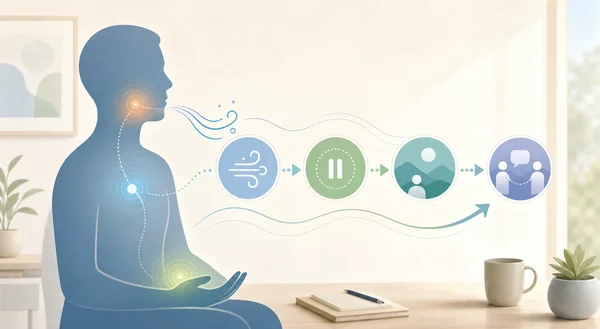
A Five-Step Reset for How to Control Your Emotions in the Moment
When emotions rise quickly, long reflection may not be realistic. You need a short reset you can remember while standing in a kitchen, sitting in a meeting, reading a message, or trying not to say the sentence that will make things worse. Use this five-step sequence as a flexible practice.
1. Notice the body signal
Before you name the emotion, notice the body. Your shoulders may lift, your hands may tighten, your stomach may drop, or your breathing may become shallow. These signals are useful because they often appear before the full story forms in your mind.
Try a quiet sentence: "Something in me is activated." That wording is simple, but it interrupts the automatic belief that the only problem is outside you. It also avoids judging the feeling as bad.
2. Name the emotion with more precision
"I'm upset" is a start, but precision gives you more choices. Are you angry, embarrassed, rejected, disappointed, afraid, ashamed, overwhelmed, jealous, or tired? Each label points toward a different need.
Anger may show you a boundary. Sadness may show you a loss. Fear may show you uncertainty. Shame may show you a tender place where you feel exposed. Naming the emotion does not make it disappear, but it can make it less blurry.
3. Delay the first reaction
Many emotional problems are not caused by having a feeling. They are caused by obeying the first impulse without review. Delay is the practical middle ground between exploding and disappearing.
You can delay by taking one sip of water, reading the message twice, placing both feet on the floor, asking for a minute, or saying, "I want to answer this well, so I need a moment." This is especially useful when learning emotional intelligence skills, because it gives self-awareness time to become behavior.
4. Breathe to lower the intensity, not erase the emotion
Breathing is not magic, but it can reduce the physical pressure that makes a reaction feel urgent. Try a slow inhale through the nose, a slightly longer exhale, and a relaxed jaw. Repeat three times if you can.
The goal is not to become peaceful instantly. The goal is to create just enough room for your next thought to be wiser than your first impulse.
5. Choose the next useful action
Ask one question: "What action would I still respect tomorrow?" The answer may be to speak honestly, ask a clarifying question, pause the conversation, apologize for your tone, set a boundary, or leave the situation respectfully.
This step turns emotional control into conduct. You may still feel hurt or angry, but your behavior becomes more aligned with your values.

How to Control Your Emotions in a Relationship
Relationship emotions can feel stronger because the stakes are personal. A small delay in a reply, a change in tone, or a repeated disagreement can touch deeper needs for respect, closeness, safety, or independence. The more important the relationship is, the easier it is to confuse intensity with certainty.
Start by separating the event from the story. The event might be, "They were quiet at dinner." The story might be, "They are tired of me," or "They don't care." The story may be possible, but it is not yet proven. Emotional regulation asks you to respond to what you know while staying curious about what you do not know.
Then use language that owns your experience without making the other person responsible for every feeling. For example:
- "I felt dismissed when the topic changed quickly."
- "I need a minute because I can feel myself getting defensive."
- "I want to understand what you meant before I react."
- "This matters to me, and I want us to talk about it without blaming each other."
These sentences do not make you weak. They make the conversation easier to repair. In relationships, emotional control is not about always staying serene. It is about reducing the damage caused by unfiltered fear, pride, or defensiveness.
If you cry easily when emotions rise, treat crying as a body response, not a personal failure. Slow your breathing, lower the pace of the conversation, and name what is happening if it feels safe: "I'm overwhelmed, but I still want to talk." If the other person is not able to stay respectful, it is reasonable to pause and return later.
How to Not Let Someone Bother You So Much
Not letting someone bother you is not the same as pretending their behavior is fine. Sometimes the healthiest response is a boundary, a direct conversation, or distance. Emotional control helps you choose which one fits, rather than letting irritation choose for you.
Begin with the difference between impact and interpretation. Impact is what happened in you: embarrassment, tension, sadness, anger, or worry. Interpretation is the meaning your mind adds: "They did it on purpose," "Everyone agrees with them," or "I must respond right away." The interpretation may be accurate, partly accurate, or completely incomplete.
Use a three-question check:
- What exactly happened?
- What am I assuming?
- What response would protect my dignity without escalating the situation?
This check is useful in group chats, workplace feedback, family tension, and social media conflict. It helps you stop feeding the moment with extra certainty.
You can also reduce emotional reactivity by deciding in advance what deserves your energy. Not every comment needs a defense. Not every misunderstanding needs a speech. Not every tense person needs access to your full emotional attention. Emotional maturity includes choosing where your attention goes.

Turn Emotional Control Into an EQ Practice
The power of not reacting is not about becoming passive. It is about adding a short space between feeling and behavior, then using that space to act with more intention. Over time, that space becomes a skill you can build through reflection.
After a charged moment, ask yourself:
- What emotion showed up first?
- What did my body do?
- What story did I tell myself?
- What did I do that helped?
- What would I practice next time?
This reflection turns a difficult moment into useful information. It also makes emotional control less dependent on willpower. You begin to see patterns: the topics that trigger you, the people who activate defensiveness, the times of day when you are more reactive, and the needs you often ignore until they come out sharply.
For a gentle next step, you can use a personal EQ growth snapshot to connect emotional control with broader skills like self-awareness, empathy, motivation, and social communication. Use any result as a starting point for reflection, not as a fixed label. Emotional intelligence grows through repeated moments of noticing, pausing, repairing, and choosing again.

FAQ
How do I control my emotions?
Start by noticing the body signal, naming the emotion, delaying your first reaction, breathing slowly, and choosing one useful next action. The aim is not to remove the feeling. The aim is to keep the feeling from choosing your behavior for you.
Can you control your emotions completely?
No one controls emotions completely. Feelings can appear quickly and strongly, especially during stress, conflict, loss, or uncertainty. What you can practice is how soon you notice them, how you interpret them, and how carefully you respond.
How do you control your emotions in the moment?
Use a short reset: pause, unclench your jaw, exhale slowly, place your attention on your feet or hands, and ask, "What would I still respect tomorrow?" If the moment is too intense, step away respectfully and return when you can think more clearly.
How do you control your emotions in a relationship?
Separate the event from the story you are telling about it. Then use language that owns your feeling without blaming: "I felt hurt when that happened," or "I need a minute before I answer." Healthy emotional control supports honesty and repair.
What part of your brain controls emotions?
There is no single emotional control switch in the brain. Emotion involves several systems that help you notice threat, remember experiences, read social cues, and plan behavior. In practical terms, body awareness and pause skills can help your reflective thinking catch up.
What are signs of low emotional intelligence?
Possible signs include reacting before listening, blaming others for every feeling, struggling to apologize, missing social cues, avoiding feedback, or having repeated conflicts that follow the same pattern. These signs are not fixed traits; they are practice areas.
How do I stop crying when my emotions rise?
Try slowing your exhale, relaxing your jaw, looking at a stable object, and speaking in shorter sentences. You can also say, "I'm overwhelmed, but I want to continue carefully." If crying is frequent, distressing, or interfering with daily life, consider support from a qualified professional.