Improve Self-Management EQ After Your Test: 8 Exercises
So, you’ve just taken an EQ test. You have a score in front of you that gives you a new perspective on your emotional intelligence. It’s an exciting and insightful first step. But it often leads to a crucial question: What do I do with this information now?
If your results highlighted self-management as an area for growth, you're in the right place. Self-management, one of the five core components of emotional intelligence, is your ability to control your feelings, thoughts, and behaviors in different situations. Here's the best part: self-management isn't set in stone. You can build it, step by step. Understanding your starting point is the first step, which is why a reliable EQ test is so valuable.
This guide will walk you through what your self-management score means and provide eight practical, science-backed exercises to help you improve it. Think of this as your personal training plan for emotional fitness.
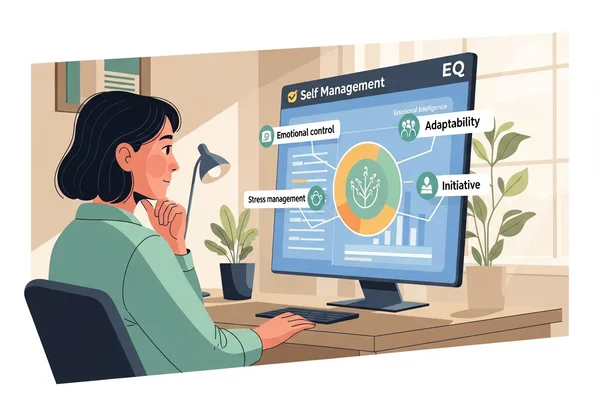
Understanding Your Self-Management EQ Test Results
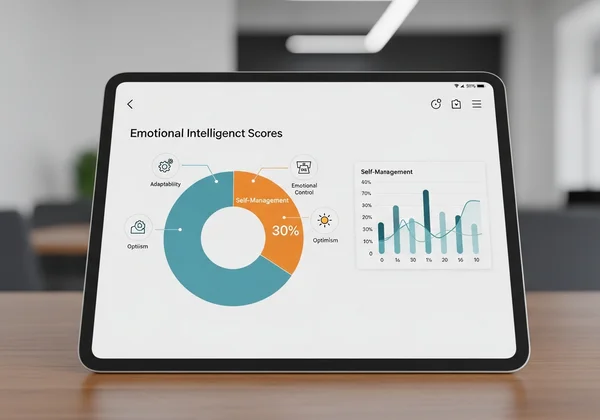
Before you can build a muscle, you need to understand how it works. The same is true for self-management. Your EQ test results offer a snapshot of your current strengths and challenges, providing a clear starting point for your personal growth journey.
What Self-Management Means for Your Emotional Intelligence
Put simply, it's staying cool at the wheel when emotions hit rough waters. It’s about managing your internal world so you can navigate the external world effectively.
This skill includes several key abilities:
- Emotional Control: Resisting impulsive reactions and staying composed under pressure.
- Adaptability: Being flexible and handling change without getting overwhelmed.
- Conscientiousness: Taking responsibility for your actions and meeting your commitments.
- Optimism: Maintaining a positive outlook and seeing setbacks as temporary hurdles.
Strong self-management helps you think clearly and make better decisions. It also builds trust in your personal and work relationships.
Common Challenges in Self-Management & How Your EQ Score Reflects Them
Does your EQ test score for self-management feel a bit lower than you expected? Don’t worry—this is incredibly common and, more importantly, a fantastic opportunity for growth. A lower score in this area might simply reflect everyday behaviors you’d like to change.
Do any of these sound familiar?
- Procrastination: Putting off important tasks until the last minute.
- Emotional Outbursts: Reacting with anger or frustration when things don’t go your way.
- Difficulty with Change: Feeling anxious or resistant when routines are disrupted.
- Giving Up Easily: Losing motivation when faced with obstacles.
Your score isn't a label. It's a spotlight on where to focus. Use it to make real, positive changes. To get a clear picture of your unique profile, you can start your assessment and get personalized results in minutes.
8 Practical Emotional Intelligence Exercises to Boost Self-Control
Ready to start building your self-management skills? These eight emotional intelligence exercises are simple, effective, and easy to integrate into your daily routine. Consistency is the key to success.

Exercise 1: The "Pause & Reflect" Technique for Emotional Regulation
The single most powerful self-management tool is the pause. It’s the small space you create between a feeling (the trigger) and your reaction. When you feel a strong emotion like anger or anxiety rising, stop.
Try this next time:
- Take one deep breath. Inhale for four seconds, hold for four, and exhale for four.
- Ask yourself three questions: What am I feeling right now? Why am I feeling this? What is a constructive way to respond?
This simple act breaks the cycle of impulsive reaction and gives your rational brain a chance to catch up.
Exercise 2: Identify Your Triggers with an Emotional Journal
You can’t manage what you don’t understand. An emotional journal helps you identify the specific people, situations, or thoughts that trigger your unwanted reactions. At the end of each day, take five minutes to jot down any moments where you felt emotionally overwhelmed.
For each entry, note:
- The Trigger: What happened right before you felt the emotion?
- The Feeling: Name the emotion (e.g., frustration, disappointment, jealousy).
- Your Reaction: How did you behave?
- A Better Reaction: How would you have preferred to react?
This practice reveals patterns over time, making your triggers predictable and therefore manageable.

Exercise 3: Practice Mindful Breathing for Stress Reduction
When you’re stressed, your body enters "fight or flight" mode. Mindful breathing is a quick way to signal to your nervous system that it’s safe to calm down.
Try the "Box Breathing" technique:
- Inhale slowly through your nose for a count of four.
- Hold your breath for a count of four.
- Exhale slowly through your mouth for a count of four.
- Hold your breath for a count of four.
Repeat this cycle for 1-2 minutes. It’s a discreet and powerful tool you can use before a big meeting, during a difficult conversation, or anytime you feel stressed.
Exercise 4: Setting SMART Goals for Personal Accountability
Self-management is closely linked to accountability—doing what you say you will do. Vague goals like "be more organized" are hard to act on. Instead, use the SMART framework to set clear, achievable targets.
- Specific: What exactly do you want to accomplish?
- Measurable: How will you track your progress?
- Achievable: Is this goal realistic for you right now?
- Relevant: Does this goal align with your values?
- Time-bound: When will you achieve this by?
For example, instead of "I'll stop procrastinating," a SMART goal would be: "I will finish the first draft of my project report by Friday at 5 PM."
Exercise 5: The Power of Proactive Planning to Avoid Reactivity
Daily stress often hits from surprises. Get ahead: plan proactively to dodge those emotional flare-ups.
- Plan your day the night before: Spend 10 minutes outlining your top three priorities for the next day.
- Prepare for triggers: If you know meetings with a certain colleague are stressful, plan your talking points and calming strategies beforehand.
This shifts your mindset from being a victim of your circumstances to being the architect of your day.
Exercise 6: Cultivate Optimism Through Gratitude Practices
Optimism isn't about ignoring reality; it's about training your brain to see possibilities and opportunities, even amidst challenges. A simple gratitude practice can rewire your neural pathways for positivity.
Each night, write down three specific things that went well during the day and your role in making them happen. For example: "I finished my report on time because I focused and didn't get distracted." This builds self-efficacy and a more positive outlook.
Exercise 7: Embrace Adaptability with "What If" Scenarios
Adaptability is about being resilient when plans change. You can train this skill through mental rehearsal. Before a significant event, take a moment to play out a few "what if" scenarios.
For example, if you have a presentation:
- "What if the projector fails?" (My backup plan is to use handouts.)
- "What if someone asks a question I can't answer?" (I'll say, "That's a great question, let me look into that and get back to you.")
This mental preparation reduces anxiety and helps you respond flexibly instead of freezing under pressure.
Exercise 8: Seek Constructive Feedback for Growth
We often have blind spots when it comes to our own behavior. Asking for feedback from a trusted friend, mentor, or colleague can provide invaluable insights into how your self-management skills are perceived by others.
Ask specific questions like:
- "Can you give me an example of a time when I handled a stressful situation well?"
- "In which situations do you think I could improve my emotional response?"
Listen with an open mind, thank them for their honesty, and use their insights to refine your approach. If you're looking for a data-driven starting point, an accurate EQ test can provide that initial, private feedback.
Let's Get You Started on Stronger Self-Control
Improving your self-management isn't a one-and-done fix; it's a journey of small, daily efforts. Think of your EQ test results as the map and these eight exercises as your toolkit for moving forward.
Every time you choose to pause instead of react, or plan instead of procrastinate, you're strengthening your emotional intelligence. That leads directly to less stress, better decisions, stronger relationships, and a real sense of control over your life.
Ready to discover your unique emotional intelligence profile and get a personalized roadmap for growth? Start your free EQ test today and unlock the insights you need to master your emotions.
Frequently Asked Questions About EQ Self-Management
How can I test my EQ for free?
There are many tools available online, but it's important to choose one grounded in psychological science. A great place to start is right here. You can test your EQ for free on our platform to receive an immediate score and a summary of your emotional intelligence profile.
Can I really raise my EQ, and how long does it take?
Yes, absolutely! Unlike IQ, which is relatively stable, emotional intelligence is a flexible set of skills that can be learned and improved at any age. The timeline for improvement varies from person to person, but with consistent practice of exercises like the ones above, most people start to notice positive changes in their reactions and mindset within a few weeks.
What are the signs of low emotional intelligence in daily life?
Some common signs include having trouble handling criticism, frequently getting into arguments, blaming others for problems, having emotional outbursts, and finding it difficult to understand or listen to other people's perspectives. Recognizing these signs is the first step toward making a change.
Is high EQ or IQ better for career success?
Both are important, but modern research suggests that EQ is often the key differentiator, especially in leadership roles. IQ might land the job. But high EQ lets you team up, handle stress, inspire others, and tackle office drama. That's what drives career wins long-term.