Emotional Intelligence 2.0 Summary: Key Ideas, Chapter Guide, and Practical EQ Takeaways
If you are searching for an Emotional Intelligence 2.0 summary, you probably want more than a few motivational quotes. Travis Bradberry and Jean Greaves wrote the book as a practical EQ improvement guide: understand your emotional patterns, choose one skill to improve, practice specific behaviors, and track change over time. For readers who want to connect the book's ideas with a simple self-reflection starting point, an online EQ self-assessment can help organize what you notice about self-awareness, self-management, empathy, and relationship habits.
This guide gives you a clear book summary, a chapter-style map, a practical cheat sheet, and a balanced book review. It also separates Emotional Intelligence 2.0 from the professional EQ-i 2.0 assessment and from newer Bradberry material, so you do not mix up similar names.
What Emotional Intelligence 2.0 Is Really About
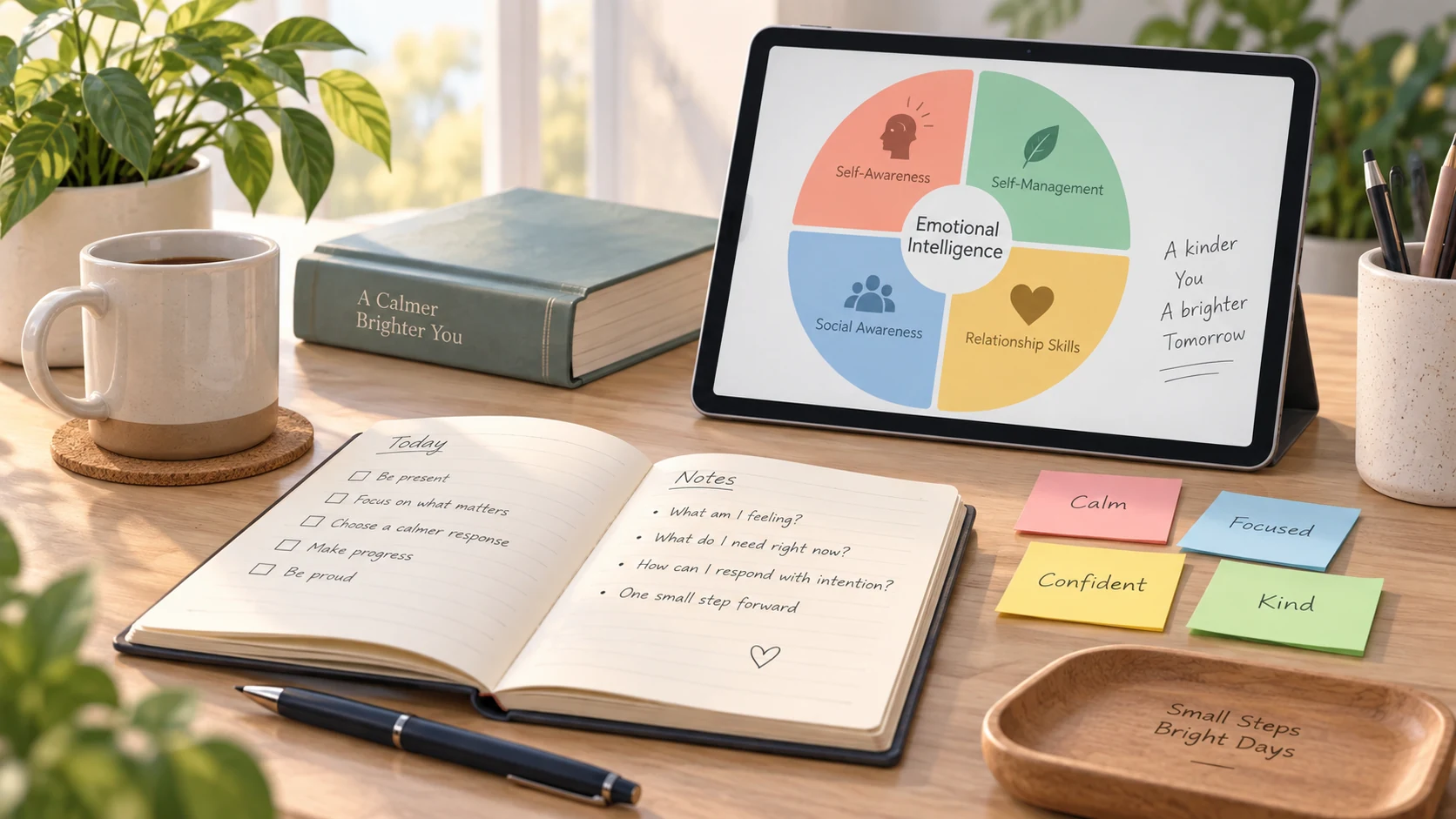
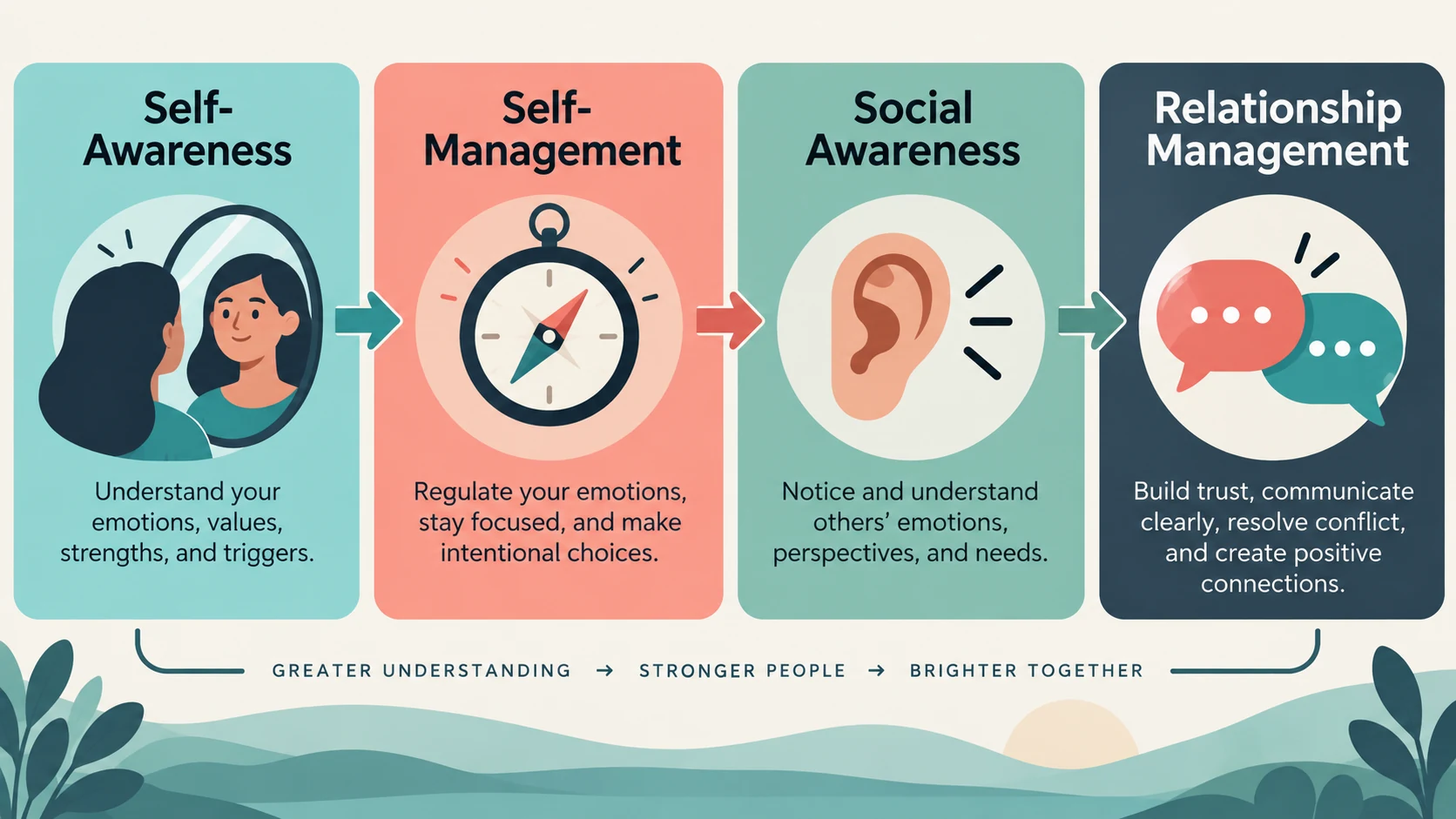
Emotional Intelligence 2.0 is built around a simple idea: EQ is the ability to recognize emotions in yourself and others, then use that awareness to guide behavior and relationships. The book focuses less on theory and more on practice. Its four core skills are self-awareness, self-management, social awareness, and relationship management.
The authors group the first two skills under personal competence. Self-awareness is noticing what you feel and why it matters. Self-management is using that awareness to respond with more intention. The second two skills belong to social competence. Social awareness is reading other people's emotions and context. Relationship management is applying that awareness during communication, conflict, feedback, and trust building.
That practical frame is why the book still ranks well for searches like Emotional Intelligence 2.0 book review, Emotional Intelligence 2.0 test, and Emotional Intelligence 2.0 TalentSmart. Readers often want a workbook-like path, not a purely academic explanation. The book also became known for pairing reading with an access-code assessment, although access depends on owning a valid copy and the publisher's current process.
One important caution: an EQ score is not a fixed label. It is better treated as a snapshot for reflection. EQTest.co uses the same educational spirit when it presents a quick emotional intelligence test as a way to think about patterns, not as a clinical judgment or a permanent identity.
Emotional Intelligence 2.0 Summary by Chapter and Skill
Many readers ask for an Emotional Intelligence 2.0 summary by chapter. The book is not best remembered as a plot-like chapter sequence. It works more like a skill manual: define EQ, explain why emotion can outrun logic, introduce the four skills, then offer short strategies for practicing each skill.
Chapter 1 and the Core Message
The opening idea is that emotion and reason are connected. When something happens, emotional reactions can arrive quickly, sometimes before slower reflection catches up. The goal is not to eliminate emotion. The goal is to notice emotion early enough that it becomes useful information rather than automatic behavior.
In a short summary, emotional intelligence means noticing feelings, understanding their source, reading the emotional context around you, and choosing a response that supports the situation. That definition is simple, but the book's practical claim is harder: EQ improves through repeated behavior, feedback, and attention.
Self-Awareness
Self-awareness is the foundation because you cannot manage a feeling you have not noticed. The book encourages readers to identify emotional triggers, observe how moods affect decisions, and ask how other people experience their behavior.
A useful takeaway is to name emotions with more precision. "Bad" is vague. Irritated, disappointed, embarrassed, pressured, or resentful each points to a different need. The more accurate the label, the easier it becomes to choose a response.
Self-Management
Self-management turns awareness into action. This is where the book becomes especially practical. Strategies include pausing before reacting, separating emotional and logical arguments, choosing self-talk carefully, and creating routines that reduce impulsive decisions.
This section is useful for workplace readers because self-management often shows up in small moments: whether you send the sharp email, interrupt a tense meeting, avoid feedback, or slow down long enough to ask a better question.
Social Awareness
Social awareness is the ability to pay attention to other people with enough patience to understand what may be happening beneath the words. The book's social awareness strategies lean on listening, observing tone and body language, and checking assumptions.
This matters because many communication problems are not caused by missing vocabulary. They come from missed context. Someone may say "fine" while their tone, timing, or avoidance says something else. Social awareness asks you to slow down and gather more evidence before deciding what a person means.
Relationship Management
Relationship management is the applied skill. It combines your emotional awareness with another person's emotional reality. It includes repairing misunderstandings, giving feedback respectfully, explaining intent, and staying present during tension.
The strongest takeaway is that relationships are managed over time, not only during conflict. Trust grows through consistency: clear words, aligned body language, follow-through, and the willingness to revisit a conversation when the first attempt did not land well.
Emotional Intelligence 2.0 Cheat Sheet
If you wanted an Emotional Intelligence 2.0 cheat sheet PDF, use this section as a quick reference instead of hunting for unauthorized copies of the book.
| Skill | What to notice | One practice |
|---|---|---|
| Self-awareness | Your triggers, moods, and repeated reactions | Name the exact emotion before acting |
| Self-management | The gap between feeling and behavior | Pause, breathe, and choose the next useful step |
| Social awareness | Other people's tone, timing, and context | Listen without preparing your reply too early |
| Relationship management | Trust, clarity, repair, and follow-through | Summarize what you heard before responding |
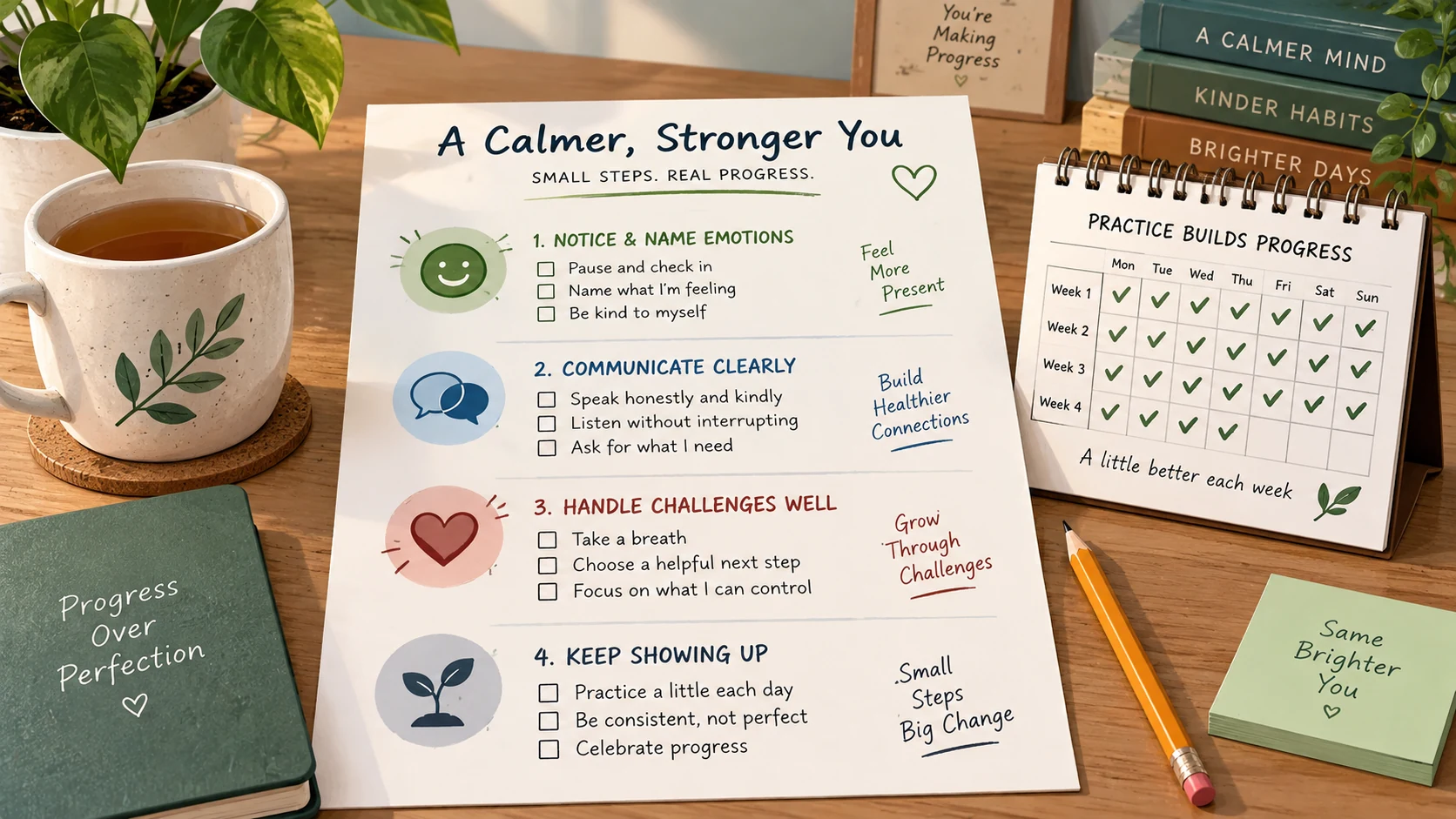
A simple weekly practice is to pick one skill and one situation. For example, if social awareness is your focus, choose one recurring meeting or family conversation. During that moment, track tone, facial expression, pacing, and what is not being said. Afterward, write down one assumption you made and one question you could ask next time.
For self-management, try an emotion-versus-logic note. On one side, write what the feeling is pushing you to do. On the other, write what the facts suggest. The point is not to let logic "win" every time. The point is to let both sources of information sit where you can see them.
How to Use the Book With an EQ Test
Emotional Intelligence 2.0 is often searched with terms such as TalentSmart EQ test, emotional intelligence appraisal test, and emotional intelligence 2.0 code. Those searches point to the book's assessment ecosystem, but readers should distinguish three things.
First, Emotional Intelligence 2.0 is a book by Travis Bradberry and Jean Greaves, originally published by TalentSmart, with print ISBN 9780974320625. Second, the book-associated appraisal is a specific access-code experience tied to the publisher's materials. Third, EQ-i 2.0 is a separate professional assessment from Multi-Health Systems. EQ-i 2.0 measures emotional and social skills across areas such as self-perception, self-expression, interpersonal functioning, decision making, and stress management. It is typically used by qualified professionals in coaching, organizational, and research contexts.
For everyday readers, the practical move is simpler. Read the book for language and strategy. Use a self-reflection tool to notice your current patterns. Then choose one behavior to practice for a few weeks.
Is Emotional Intelligence 2.0 Still Worth Reading?
Yes, Emotional Intelligence 2.0 is still worth reading if you want practical EQ language and behavior prompts. It is especially useful for readers who prefer short strategies over dense theory. It is also a good entry point for teams, managers, students, and coaches who want shared vocabulary for emotions at work or in relationships.
The book has limits. Some claims about EQ and performance should be read with healthy caution, because emotional intelligence research includes different models, measures, and debates. The book is strongest when treated as a practice guide, not as the final word on psychology.
It is also worth knowing about The New Emotional Intelligence by Travis Bradberry. That newer book keeps the four-skill model but updates the program with new strategies, a newer assessment experience, and video-based learning support. In simple terms, Emotional Intelligence 2.0 is the earlier practical classic by Bradberry and Greaves; The New Emotional Intelligence is Bradberry's later update for modern work and life.
The best use of any emotional intelligence summary is action. Choose one real conversation, one trigger, or one listening habit. Track it. Reflect on it. If you want a low-pressure way to compare your current habits with common EQ dimensions, an EQ reflection tool for personal growth can support that first step. Ask for feedback when appropriate. Then repeat. That is where a book summary turns into better communication and stronger self-awareness.
FAQ
What does the EQ-i 2.0 measure?
EQ-i 2.0 is a professional emotional intelligence assessment that measures emotional and social functioning. Its model includes areas related to how people perceive and express themselves, build relationships, make decisions, and cope with stress. It is different from Emotional Intelligence 2.0, which is a book, and from general online EQ self-reflection tools.
What is emotional intelligence in a short summary?
Emotional intelligence is the ability to notice emotions in yourself and others, understand what those emotions may mean, and use that awareness to guide behavior. In practical terms, it affects how you handle stress, listen, respond to conflict, build trust, and repair misunderstandings.
Is Emotional Intelligence 2.0 a good book?
It is a good book for readers who want practical strategies and simple language. It may feel too simplified for readers looking for academic depth, but it is useful as a starter guide for noticing patterns and building everyday emotional skills.
Is there an Emotional Intelligence 2.0 PDF?
Many people search for an Emotional Intelligence 2.0 PDF or summary PDF, but the safest route is to use legitimate book retailers, libraries, or authorized digital editions. For quick learning, a legal summary like this one can help you decide whether the full book is worth reading.
What is the Emotional Intelligence 2.0 table of contents?
The book is commonly understood around an introduction to EQ, the four skills of self-awareness, self-management, social awareness, and relationship management, plus many short strategies for practice. Exact table-of-contents details can vary by edition and format, so check your copy for the official sequence.
What are Emotional Intelligence 2.0 social awareness strategies?
Social awareness strategies include listening fully, observing nonverbal cues, noticing mood shifts, checking assumptions, and considering context before responding. The goal is not mind reading. The goal is to slow down enough to understand people more accurately.
What are the differences between Emotional Intelligence 2.0 and The New Emotional Intelligence?
Emotional Intelligence 2.0 is the earlier book by Travis Bradberry and Jean Greaves, known for its four-skill model and practical strategies. The New Emotional Intelligence is Travis Bradberry's later book. It keeps the four core skills but presents updated strategies, a newer test experience, and additional learning support.